AI led progression
Agile vs AI Progression
Matt Dahlberg
·
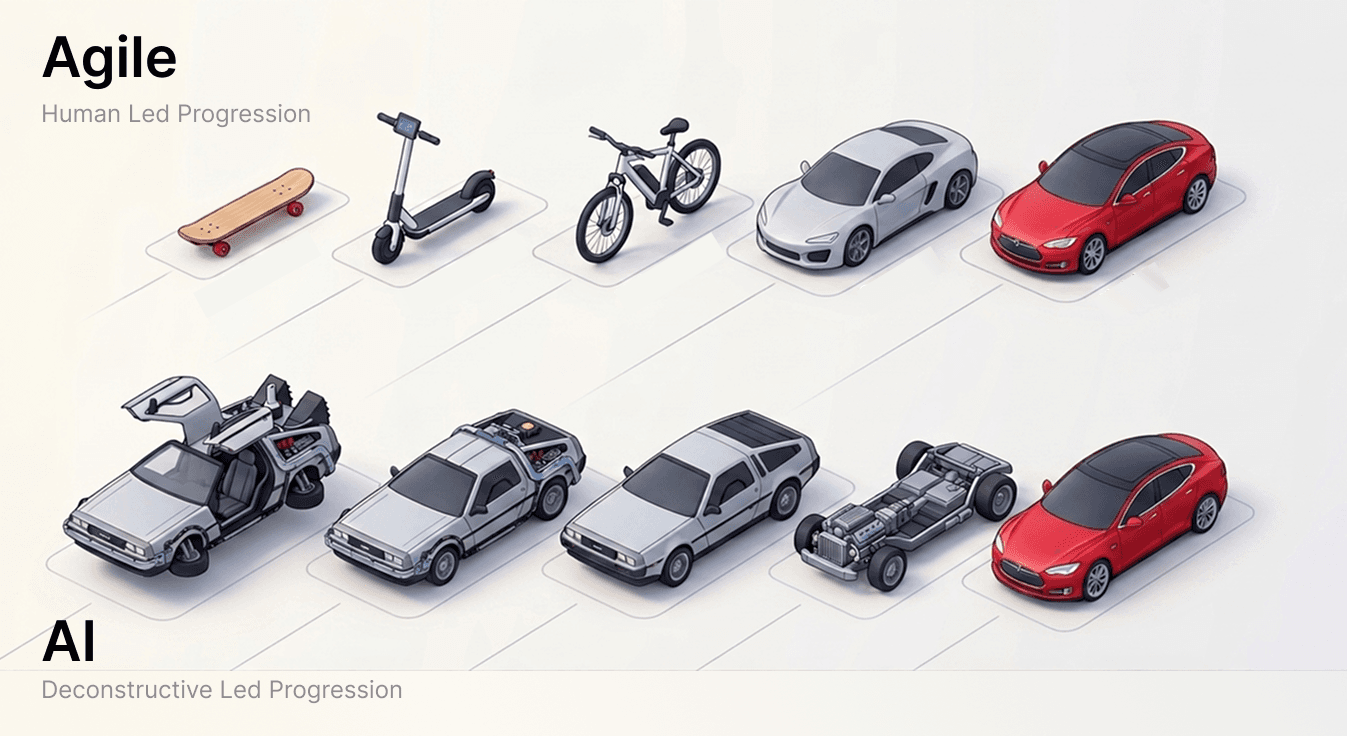
I’ve been thinking a lot about how software gets built lately, especially after years of having the traditional "Agile" model drilled into my head. Starting small, build linear progress and add features piece by piece until you get to something that is good enough. And someday you'll schedule a Jira ticket to come back and make it slightly better or add polish. Using AI completely flips this workflow upside down.
Instead of starting small and adding on, building with AI feels like a deconstructive process. An AI coding agent can essentially hand you a super complex, maximum capability version of your idea. The job of the builder changes from brick by brick construction to stripping away the extra noise, tuning the features, and refining it into that clean, final production version.
The idea clicked for me while listening to a podcast episode with the Head of Design at Anthropic on The Product Podcast with Meaghan Choi. She was talking about how their small teams use fleets of AI agents to ship value at unheard of speed.
One of the coolest takeaways was how this level of speed and abundant output fundamentally changes the team dynamic. She emphasized that anyone can push to production, which makes rigid job titles feel a lot less important. Titles become more about a unique specialization rather than a boundary. When a company is moving that fast, it's not even about people wearing "multiple hats", it's more like everyone is collectively wearing all the hats to keep up with the momentum.
Hearing her describe that environment made me realize that the old boundaries of who can contribute and how fast things move are just completely different now.
It felt like a totally new way of looking at product development, and it made me look at our local tech scene here in Utah. I've yet to see much adoption of "start big, refine fast" mindset. Legacy habits and traditional Agile frameworks die hard, and it takes time for teams to shift.
But for startups or anyone trying to move quickly, breaking away from that strict Agile model feels like a massive shortcut to value, learning and creation. It’s just interesting to see the playbook shift in real time from building up to pairing down.
Once again my short post is most likely insufficent to paint the big picture and why I'd highly recommned listening to the podcast to fully understand where software development is heading.